
Why Happy Customers Don’t Leave Reviews and How to Fix It
- Review Buddy

Summary
Most customers do not skip Google reviews because they are unhappy. They skip them because they are busy, distracted, or never asked at the right moment. A customer can have a great experience and still forget to leave a review five minutes later.
For local businesses, this creates a serious problem. Happy customers leave quietly, while frustrated customers are often more motivated to write something. That means your online reputation may not reflect the real quality of your business.
The fix is not pressure. The fix is a better system: ask at the right time, make the request personal, explain why it matters, and give customers an easy direct link.
Key takeaways
- Happy customers often forget to leave reviews because life moves fast after the purchase or appointment.
- The best time to ask for a Google review is when the positive experience is still fresh.
- Generic review requests get ignored because they feel robotic.
- Customers are more likely to respond when they feel personally appreciated.
- Every extra step lowers the chance of getting a review.
- Asking for honest feedback is safer and more trustworthy than asking for 5 stars.
- A consistent review system works better than relying on staff to remember every time.
Why Google Reviews Matter So Much
Google reviews are one of the first things people check before choosing a local business.
BrightLocal’s 2026 Local Consumer Review Survey found that 97% of consumers read reviews for local businesses and 71% use Google to read local business reviews. That means your Google review profile is often shaping trust before someone visits your website, calls your business, or books an appointment.
Reviews affect three important things:
- Trust
People want proof that other customers had a good experience. - Visibility
A stronger review profile can support local search performance. - Conversion
More positive reviews can make customers more confident to contact you.
A business with strong reviews looks active, trusted, and established. A business with few recent reviews may look quiet, even if it does great work every day.
Your happy customers are one of your strongest marketing assets, but only if they actually leave reviews.
The Real Reason Happy Customers Don’t Leave Reviews
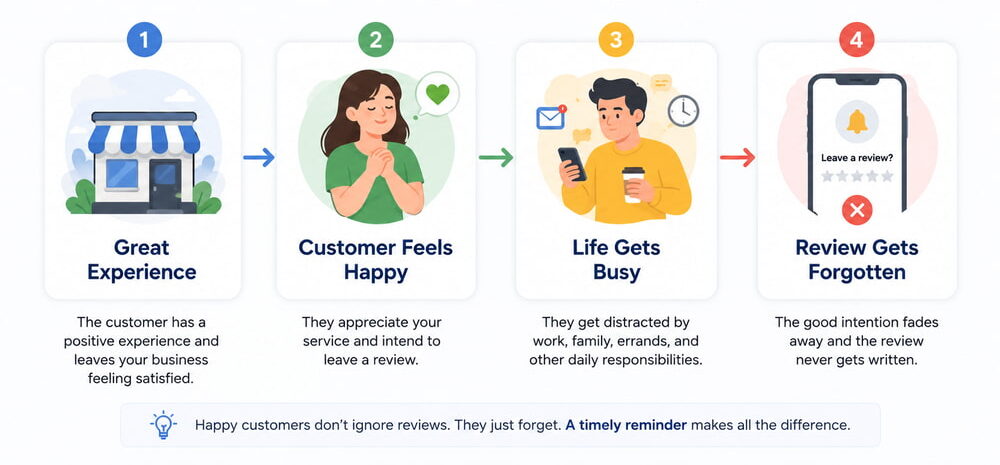
Most happy customers are not refusing to help you. They simply forget.
After a good experience, the customer moves on. They get in their car. They check their phone. They go back to work. They pick up their kids. They think about dinner. Your review request is not their top priority.
This is basic human behavior.
A customer may genuinely like your business and still never leave a review because there was no clear prompt at the right moment.
Happy customers do not automatically become public reviewers. They need a simple reminder at the right time.
This is where many businesses misunderstand the problem. They think:
“If people are happy, they will leave reviews.”
That is not true.
A few will. Most will not.
Not because they are unhappy. Because they are distracted.
The Emotional Moment Fades Fast
The best time to ask for a review is when the customer still feels the value of the experience.
This could be right after:
- A successful appointment
- A great meal
- A helpful consultation
- A completed service
- A smooth delivery
- A positive interaction with staff
- A customer says, “Thank you, this was great”
That moment matters because the customer still remembers how they felt.
Wait too long and the emotional connection fades. The customer may still like your business, but the urgency is gone.
For example, if someone leaves a clinic feeling better, that is a strong moment. If a restaurant customer finishes a great meal, that is a strong moment. If a contractor finishes a job and the homeowner is happy, that is a strong moment.
The longer you wait, the weaker the memory becomes.
The best review requests happen while the customer still feels satisfied, not days later when the experience has become old news.
Generic Review Requests Get Ignored
Most review requests sound the same.
“Please leave us a review.”
That message is not terrible, but it is weak. It gives the customer no reason to care. It feels like a task.
A better request feels personal.
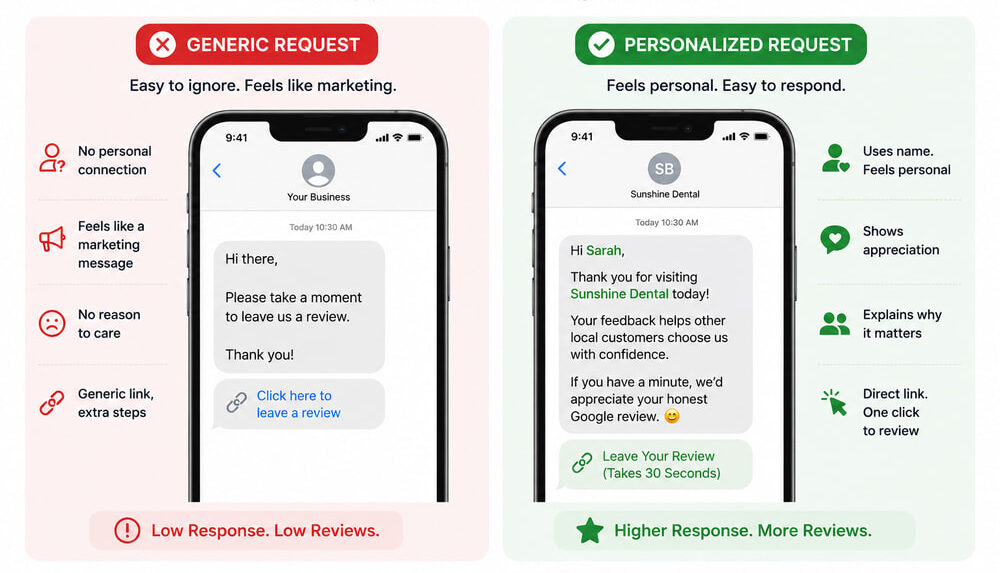
Bad example:
Dear valued customer, please leave us a review.
Better example:
Hi Sarah, thank you for visiting us today. Your feedback helps other local customers choose us with confidence. If you have a minute, we’d appreciate your honest Google review.
The second message works better because it feels human. It uses the customer’s name. It thanks them. It gives a reason. It asks for honest feedback.
That is the psychology.
People are more likely to act when they feel recognized.
A personal review request feels like appreciation. A generic review request feels like marketing.
Customers Need a Reason to Leave a Review
Most customers do not fully understand how much their review helps a local business.
They may think:
“It’s just one review. It probably doesn’t matter.”
But it does matter.
For a local business, one review can help future customers feel more confident. It can support local SEO. It can show that the business is active and trusted. It can help someone choose you instead of a competitor.
When asking for a review, give customers a simple reason.
Good phrases:
- “Your feedback helps other local customers find us.”
- “Your review helps people choose us with confidence.”
- “Your feedback helps small businesses like ours grow.”
- “It only takes a minute and means a lot to our team.”
Do not make it about begging. Make it about helping future customers.
Customers are more likely to leave a review when they understand that their feedback helps other people, not just the business.
Too Many Steps Kill the Review
If customers have to work too hard, they will not leave the review.
Do not ask them to:
- Open Google
- Search your business name
- Find the right location
- Click reviews
- Find the write review button
- Decide what to say
- Post the review
That is too much friction.
The easier path is simple:
Send a direct Google review link.
One click is better than five steps.
This is one of the biggest reasons businesses lose reviews. The customer may be willing to help, but the process is annoying. If they get interrupted halfway through, the review is gone.
Every extra step lowers the chance that a happy customer will leave a Google review.
Your review request should make the next action obvious.
Example:
If you have a minute, you can leave your Google review here: [review link]
Simple wins.
Staff Forget to Ask
Manual review asking sounds easy until real life gets in the way.
Staff are busy. Customers are waiting. Phones are ringing. Appointments run late. Orders need to be prepared. The day moves fast.
Even great staff forget.
That is not a staff problem. It is a system problem.
If your business relies on people remembering to ask every customer, your review generation will be inconsistent. Some customers will be asked. Most will not.
That is why many businesses get random review spikes, then nothing for weeks.
A better system makes review requests part of the customer journey.
For example:
- Customer completes a visit or service.
- Their name and phone number are added to the system.
- A personalized review request is sent at the right time.
- The customer receives a direct Google review link.
- One polite follow-up can be sent if needed.
This creates consistency.
Manual review asking fails because it depends on memory. A review system works because it runs every time.
That is exactly the problem Review Buddy is built to solve for local businesses.
Customers Avoid Pressure
Customers can tell when a review request feels pushy.
Do not say:
Please leave us a 5-star review.
Do not say:
Show us your review and get 10% off.
Do not say:
Only leave a review if you had a great experience.
Those lines create problems.
Google takes fake and incentivized reviews seriously. Google says businesses that violate its Fake Engagement policy may face restrictions, including limits on receiving new reviews or having reviews removed for a period of time.
The FTC also finalized a rule banning fake reviews and testimonials in 2024, including buying or selling fake consumer reviews.
The safe approach is simple:
Ask real customers for honest feedback after a real experience.
That is it.
Do not reward reviews. Do not pressure customers. Do not ask for a specific star rating.
The goal is not fake perfection. The goal is steady, authentic reviews from real customers.
Why Timing and Personalization Work Together
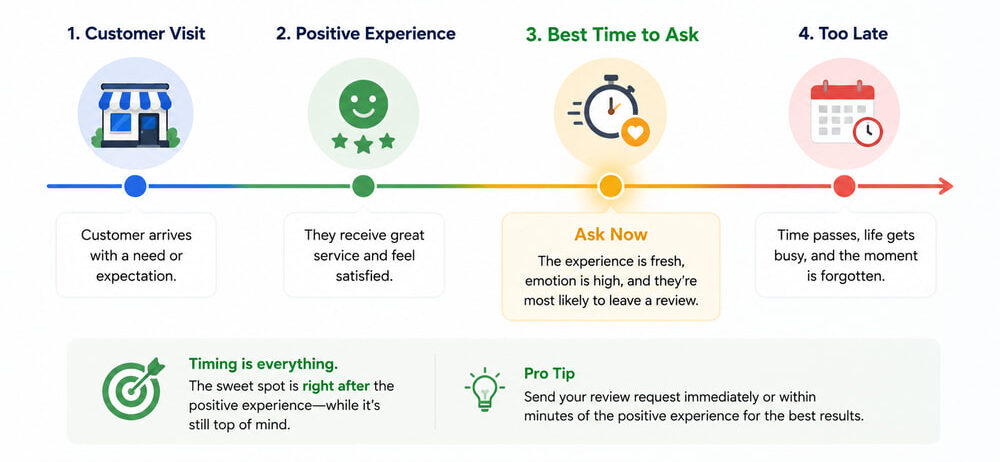
Timing gets the customer while the experience is fresh.
Personalization gets their attention.
Ease gets the review completed.
You need all three.
If the timing is right but the message is generic, it may get ignored.
If the message is personal but sent a week later, the moment may be gone.
If the message is personal and timely but does not include a direct link, the customer may not finish.
A strong review request combines:
- Customer name
- Business name
- A thank-you
- A reason
- A direct review link
- A respectful tone
Example:
Hi Sarah, thank you for visiting Island Wellness today. Your feedback helps other local customers choose us with confidence. If you have a minute, we’d appreciate your honest Google review: [link]
This is not complicated. It just needs to be consistent.
The best review request is timely, personal, respectful, and easy to complete.
Why Some Businesses Get Reviews Consistently
Businesses that get reviews consistently usually do not leave it to chance.
They have a process.
They know:
- When to ask
- Who to ask
- What message to send
- How many times to follow up
- Where to send the customer
- How to track results
Businesses that struggle usually do the opposite.
They ask randomly. They forget. They send generic messages. They wait too long. They make customers search for the review page themselves.
That is why two businesses can deliver the same quality of service but have completely different review profiles.
One has a system. The other is hoping.
Hope is not a review strategy.
How to Fix the Problem
If your customers are happy but not leaving reviews, fix the system.
Start with these steps.
1. Ask at the Right Moment
Do not wait too long.
For most local businesses, the best time is shortly after the appointment, visit, delivery, or completed service.
2. Make the Message Personal
Use the customer’s name when possible. Mention the business. Keep it warm and human.
3. Give a Clear Reason
Tell the customer why their review matters.
Example:
Your feedback helps other local customers choose us with confidence.
4. Send a Direct Google Review Link
Do not make customers search for your business. Give them the exact link.
5. Ask for Honest Feedback
Do not ask for 5 stars. Ask for an honest review.
6. Follow Up Once
One polite reminder is fine. Multiple reminders can feel pushy.
7. Automate the Process
If your team is busy, automate the request so it happens consistently.
Review Buddy helps businesses send personalized Google review requests automatically, so happy customers are reminded at the right time without staff having to remember manually.
Example Google Review Request Message
Here is a simple version you can use:
Hi [Customer Name], thank you for choosing [Business Name]. Your feedback helps other local customers find us and choose us with confidence. If you have a minute, we’d appreciate your honest Google review: [Review Link]
Here is a warmer version:
Hi [Customer Name], it was great having you in today. Thank you for trusting [Business Name]. If you have a minute, your honest feedback on Google would mean a lot and help other local customers find us: [Review Link]
Here is a follow-up version:
Hi [Customer Name], just checking in once. If you haven’t had a chance yet, we’d really appreciate your honest Google review. No pressure at all. Here’s the link: [Review Link]
Keep it short. Keep it respectful. Make it easy.
What to Avoid
Avoid these common mistakes:
Asking Too Late
A review request sent two weeks later is usually too late.
Sounding Desperate
Do not make customers feel guilty.
Bad:
We really need more reviews.
Better:
Your feedback helps other local customers choose us.
Asking for 5 Stars
Ask for honest feedback, not a specific rating.
Offering Rewards
Do not offer discounts, gifts, loyalty points, or freebies in exchange for reviews.
Sending Too Many Reminders
One follow-up is enough.
Making Customers Search
Always send the direct review link.
How Review Buddy Helps
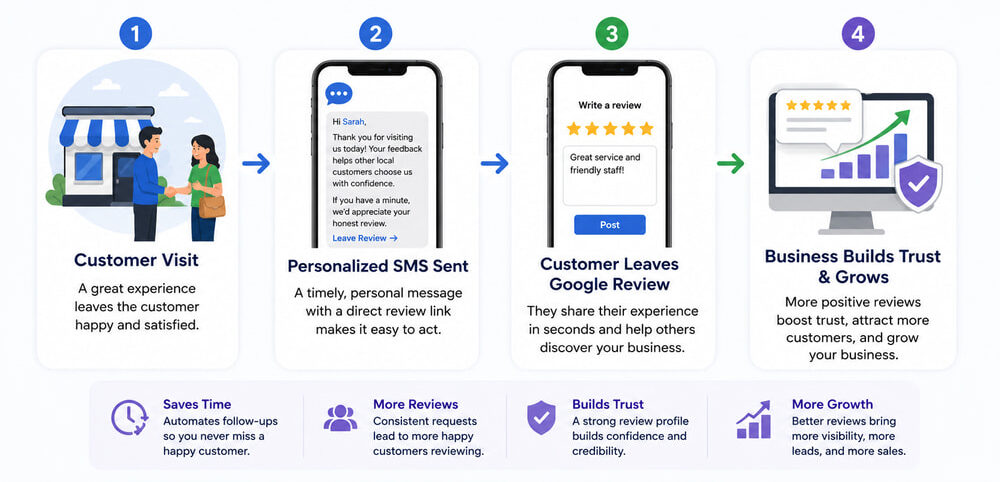
Review Buddy helps local businesses collect more Google reviews by turning the review request into a simple, automated system.
Instead of relying on staff to remember, Review Buddy helps send personalized review requests at the right moment. That means more happy customers get reminded while the experience is still fresh.
You can learn more about the system here:
If you want to see what better review generation can look like, visit:
https://reviewbuddy.ca/results/
For plan details, visit:
FAQ
Why don’t happy customers leave Google reviews?
Happy customers often forget. They may have enjoyed the experience, but once they leave, they get distracted by daily life. A timely reminder makes a big difference.
What is the best time to ask for a Google review?
The best time is shortly after a positive customer experience, while the interaction is still fresh.
Should I ask customers for 5-star reviews?
No. Ask for honest feedback. Asking for a specific rating can feel pushy and may create trust or policy issues.
Can I offer a discount for a Google review?
No. Offering rewards or discounts in exchange for reviews can violate review platform rules and damage trust.
Is SMS or email better for review requests?
For many local businesses, SMS works better because it is fast, simple, and easy to tap on mobile. Email can still work for longer or more formal customer journeys.
How many times should I follow up?
One polite follow-up is enough. More than that can feel pushy.
What should a Google review request say?
It should thank the customer, explain why their feedback matters, and include a direct Google review link.
Final Thoughts
Customers do not leave Google reviews just because they had a good experience. They leave reviews when the timing, message, and process make it easy.
Most businesses are not losing reviews because customers do not care. They are losing reviews because there is no system.
The fix is simple:
Ask at the right moment. Make it personal. Give a reason. Send the direct link. Follow up once. Keep it honest.
That is how local businesses turn more happy customers into real Google reviews without sounding pushy.

Review Buddy helps local businesses improve their online reputation, automate customer follow-ups, and generate more Google reviews with simple, personalized review request systems.