
Offering Discounts for Google Reviews Can Backfire. Here’s What to Do Instead.
- Review Buddy
Summary
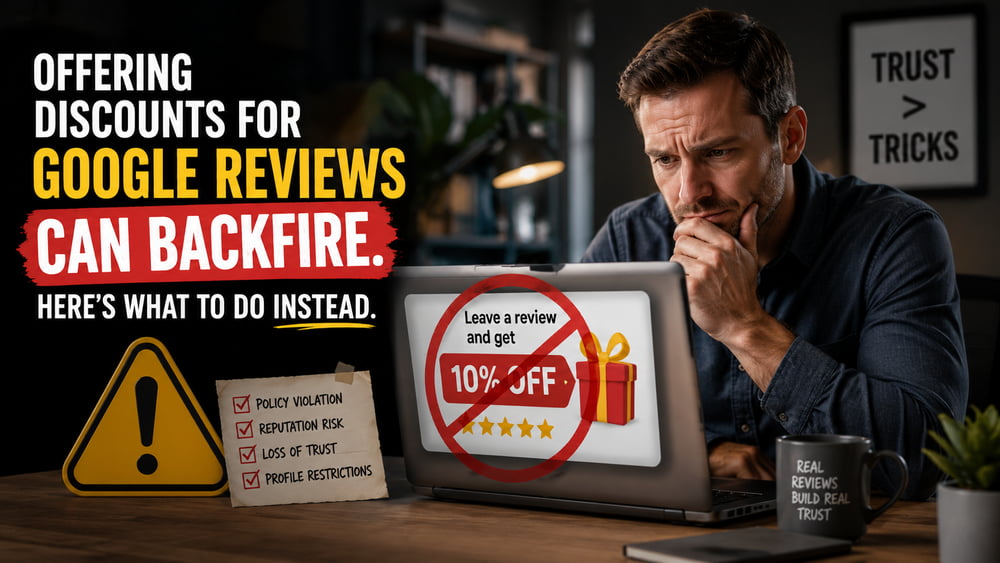
Offering discounts for Google reviews may seem like an easy way to get more reviews fast, but it can backfire.
Google says incentivized reviews are reviews influenced by payment, discounts, free goods or services, or another benefit offered to the reviewer. Google also says businesses that violate its fake engagement policy may face restrictions on their Business Profile.
That means a “10% off for a review” offer is not a smart shortcut. It can damage trust, create policy risk, and make your reviews look fake.
The better strategy is simple: ask real customers for honest feedback after a real experience. Make the request timely, personal, and easy to complete.
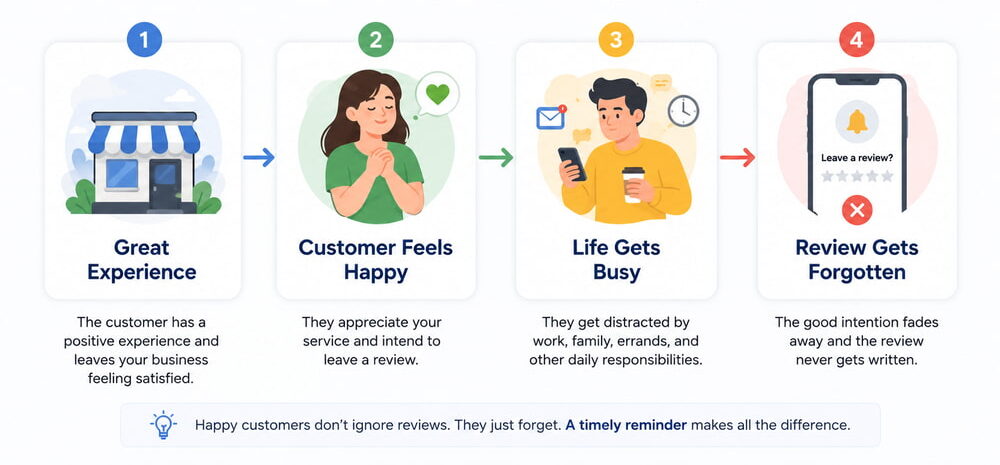
For local businesses, this creates a serious problem. Happy customers leave quietly, while frustrated customers are often more motivated to write something. That means your online reputation may not reflect the real quality of your business.
The fix is not pressure. The fix is a better system: ask at the right time, make the request personal, explain why it matters, and give customers an easy direct link.
Key takeaways
- Do not offer discounts, rewards, freebies, or loyalty points in exchange for Google reviews.
- Incentivized reviews can violate Google’s review policies.
- Fake or biased reviews can damage customer trust.
- Asking for honest feedback is safer than asking for 5-star reviews.
- A direct review link removes friction without using incentives.
- Timing and personalization work better long term than bribes.
- A consistent review system is the safest way to grow real reviews.
Why Businesses Are Tempted to Offer Discounts for Reviews
Most business owners understand that Google reviews matter.
Customers check reviews before they call, book, visit, or buy. BrightLocal’s 2026 local SEO statistics say 97% of consumers read reviews for local businesses, and 71% use Google to read local business reviews.
So the temptation is obvious.
A business owner thinks:
“If I offer customers 10% off, maybe more people will leave reviews.”
It sounds practical. It feels like a small reward for the customer and a quick win for the business.
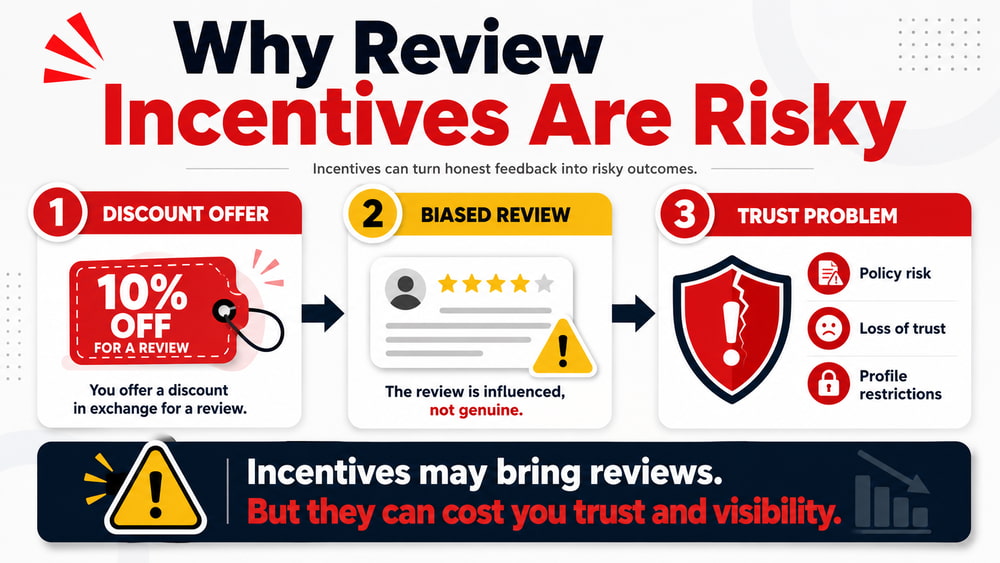
But the problem is simple: the review is no longer fully independent.
Once a customer receives a benefit for leaving a review, the review can become biased. Even if the customer writes something honest, the incentive changes the situation.
The moment you reward a review, you create doubt about whether the feedback was genuine.
That doubt is dangerous because reviews only work when customers trust them.
Can You Offer Discounts for Google Reviews?
No, not safely.
Google’s policy on incentivized or biased reviews says incentivized reviews are reviews influenced by payment, discounts, free goods or services, or any other benefit offered to the reviewer. Google says when a business offers incentives in exchange for reviews, it undermines content integrity and can mislead consumers.
So this kind of offer is risky:
Leave us a Google review and get 10% off your next visit.
Also risky:
Show us your review and get a free drink.
Also risky:
Leave a review this week and enter to win a gift card.
The incentive does not need to be large. Even a small reward can create a problem.
The issue is not only whether the review is positive. The issue is whether the review was influenced by a benefit.
A discounted review is not the same as a natural customer review.
That is why businesses should avoid incentives entirely.
What Can Happen If You Break Google’s Review Rules?
Google says it takes fake and incentivized reviews seriously. Businesses that violate the Fake Engagement policy may face restrictions on their Business Profile.
Those restrictions can include serious consequences.
Google’s Business Profile restrictions page says a profile that violates the fake engagement policy may lose the ability to receive new reviews or ratings for a period of time, have reviews or ratings unpublished, or display a warning that fake reviews were removed.
That is not worth it.
Your Google Business Profile is one of your most important local marketing assets. It helps people find you, compare you, call you, and visit your website.
Risking that profile for a few incentivized reviews is a bad trade.
A review strategy that puts your Google Business Profile at risk is not a growth strategy. It is a liability.
The FTC Is Also Cracking Down on Fake Reviews
This is not only a Google issue.
In 2024, the U.S. Federal Trade Commission announced a final rule banning fake reviews and testimonials. The FTC said the rule prohibits the sale or purchase of fake consumer reviews and allows the agency to seek civil penalties against knowing violators.
The FTC rule targets practices like fake reviews from people who did not have real experiences, reviews from nonexistent people, AI-generated fake reviews, and buying positive or negative reviews. Reuters reported that violations could result in fines up to $51,744.
This matters because review trust is now a bigger enforcement issue.
Platforms, regulators, and customers are all paying more attention.
Even if your business is not trying to scam anyone, a sloppy incentive campaign can make your review profile look manipulated.
Fake review enforcement is getting stricter, not weaker.
Why Incentivized Reviews Hurt Customer Trust
Reviews are powerful because they feel independent.
A customer trusts reviews because they believe real people are sharing real experiences.
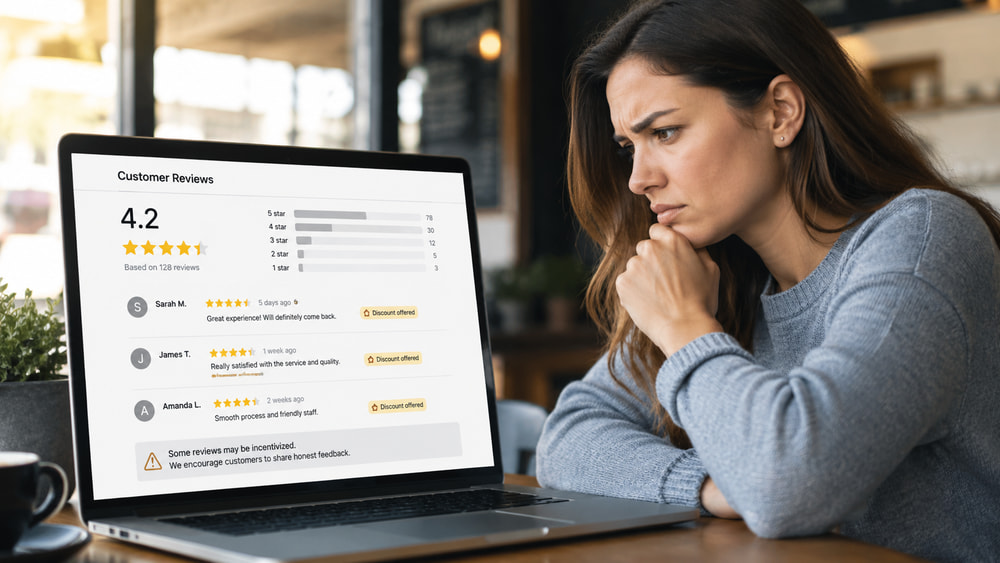
But when customers suspect reviews were paid for, discounted, or rewarded, trust drops.
Think about it from the buyer’s perspective.
If you see a business with many reviews and later find out customers got discounts for leaving them, what happens?
You question the reviews.
You wonder:
- Were the reviews honest?
- Did people only leave them for the discount?
- Did negative customers stay silent?
- Is this business manipulating its reputation?
That is the opposite of what reviews are supposed to do.
The purpose of reviews is to build trust. Incentives can destroy the trust reviews are meant to create.
For local businesses, reputation is not just about star ratings. It is about credibility.
Asking for Honest Reviews Is Allowed
Here is the important distinction.
You can ask customers for reviews.
You just should not reward them for leaving one.
Google provides tools to help businesses ask for reviews, including a review link that can be shared with customers. Google’s Business Profile Help Center says businesses can share a short URL with customers from their Business Profile dashboard.
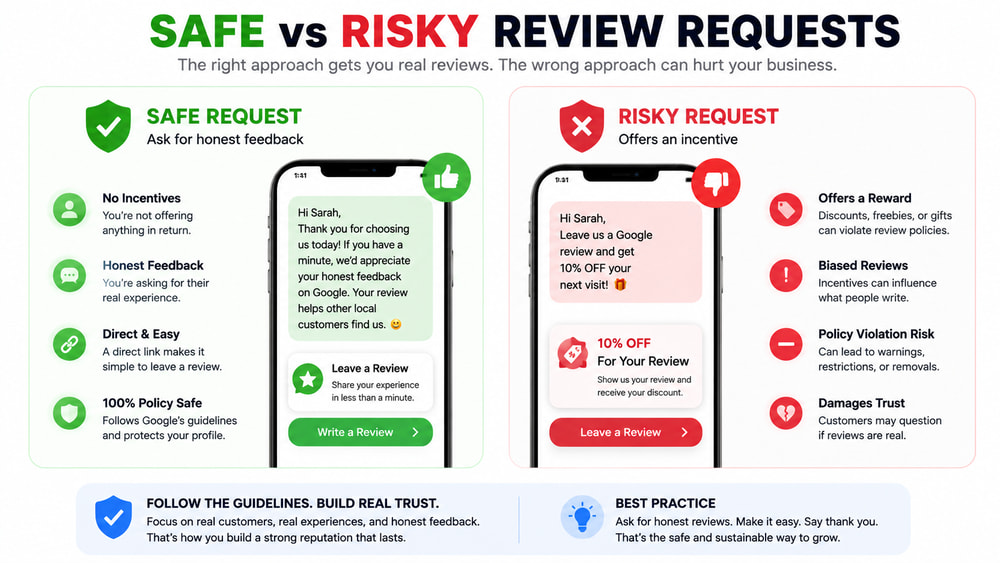
The safe version is:
Hi Sarah, thank you for visiting us today. If you have a minute, we’d appreciate your honest feedback on Google. Your review helps other local customers choose us with confidence.
The risky version is:
Leave us a Google review and get 10% off your next visit.
The difference is clear.
One asks for honest feedback.
The other pays for participation.
Asking is fine. Incentivizing is the problem.
Do Not Ask for 5-Star Reviews
Another common mistake is asking specifically for 5 stars.
Bad:
Please leave us a 5-star review.
Better:
We’d appreciate your honest feedback.
Asking for 5 stars puts pressure on the customer and makes the request feel biased.
It also creates a trust issue. Real reviews should reflect real experiences, not what the business asked the customer to write.
Google’s fake engagement policy says fake engagement is content that does not represent a genuine experience.
So keep the request neutral.
Do not script the review.
Do not ask for specific keywords.
Do not ask only happy customers.
Do not filter unhappy customers away from Google.
The safest review request asks for honest feedback, not a specific rating.
What About a Giveaway or Contest?
Avoid it.
Some businesses try to get around the rule by saying:
Leave a review and enter our giveaway.
That is still an incentive.
The customer is receiving a chance to win something in exchange for leaving a review. That can still influence the behavior.
The same applies to:
- Gift cards
- Loyalty points
- Free products
- Free services
- Discounts
- Contest entries
- Cash
- Store credit
- Bonus rewards
Do not overcomplicate this.
If the customer gets something because they left a review, it is risky.
The cleanest review strategy is no rewards, no pressure, no manipulation.
What About Asking Only Happy Customers?
Also risky.
This is often called review gating.
It works like this:
- Ask the customer if they had a good experience.
- If yes, send them to Google.
- If no, send them to a private feedback form.
That may seem smart, but it creates a biased review profile. You are filtering who gets asked publicly.
The better approach is to ask real customers for honest feedback without blocking or redirecting negative feedback away from Google.
A review profile does not need to be perfect. It needs to be real.
A few imperfect reviews can actually make your profile look more believable.
Customers do not need fake perfection. They need enough real proof to trust your business.
Why Business Owners Look for Shortcuts
Most local businesses look for shortcuts because review generation feels awkward.
Staff forget to ask.
Customers leave without reviewing.
Follow-ups take time.
Owners know competitors are getting more reviews.
So a discount looks like a fast fix.
But fast is not always smart.
Discounts can create fake-looking review patterns. They can attract low-quality reviews. They can create compliance risk. They can weaken trust.
You do not need a shortcut. You need a system.
The real problem is not that customers need to be bribed. The real problem is that most businesses do not ask properly.
What to Do Instead
Here is the safer process.
1. Ask Real Customers
Only ask people who actually used your business.
Do not ask friends, family, fake accounts, or people who never had a real customer experience.
2. Ask at the Right Time
Timing matters.
Ask shortly after a positive customer experience while the interaction is still fresh.
Examples:
- After an appointment
- After a service is completed
- After a meal
- After a purchase
- After a customer compliments your team
- After a successful delivery
Do not wait weeks.
The emotional moment fades fast.
3. Make It Personal
Generic requests get ignored.
Bad:
Please leave us a review.
Better:
Hi Sarah, thank you for visiting us today. Your feedback helps other local customers choose us with confidence.
Personalization makes the request feel human.
4. Explain Why It Matters
Customers are more likely to leave a review when they understand the impact.
Use simple language:
Your feedback helps other local customers find us.
That works better than:
We need more reviews.
The first one is customer-focused.
The second one sounds desperate.
5. Send a Direct Review Link
Do not make customers search for your business.
Send the exact Google review link.
Every extra step lowers the chance of getting the review.
6. Follow Up Once
One polite reminder is enough.
More than that can feel pushy.
7. Respond to Reviews
When customers leave reviews, reply professionally.
This shows future customers that your business is active and paying attention.
Safe Google Review Request Examples
Use these instead of discounts.
Simple Review Request
Hi [Customer Name], thank you for choosing [Business Name]. If you have a minute, we’d appreciate your honest feedback on Google. Your review helps other local customers find us: [Review Link]
Service Business Review Request
Hi [Customer Name], thank you for visiting [Business Name] today. Your feedback helps other people choose us with confidence. If you have a minute, you can leave your honest Google review here: [Review Link]
Restaurant Review Request
Hi [Customer Name], thanks for visiting [Restaurant Name]. We hope you enjoyed your meal. If you have a minute, we’d appreciate your honest feedback on Google: [Review Link]
Follow-Up Request
Hi [Customer Name], just checking in once. If you haven’t had a chance yet, we’d really appreciate your honest Google review. No pressure at all. Here’s the link: [Review Link]
These messages are clean because they ask for feedback without offering a reward.
The Better Growth Strategy: Consistency
The businesses with strong review profiles usually do not rely on one-off campaigns.
They have a consistent process.
They ask at the right time. They use a clear message. They send the direct link. They follow up once. They repeat the process every week.
That is how review profiles grow naturally.
A consistent review system is better than:
- One desperate review push
- A discount campaign
- Asking staff to remember manually
- Hoping customers leave reviews on their own
- Buying fake reviews
You do not need to bribe customers for reviews. You need to make reviewing easy for customers who already had a real experience.
That is what Review Buddy is built for.
How Review Buddy Helps You Get Reviews Without Risky Incentives
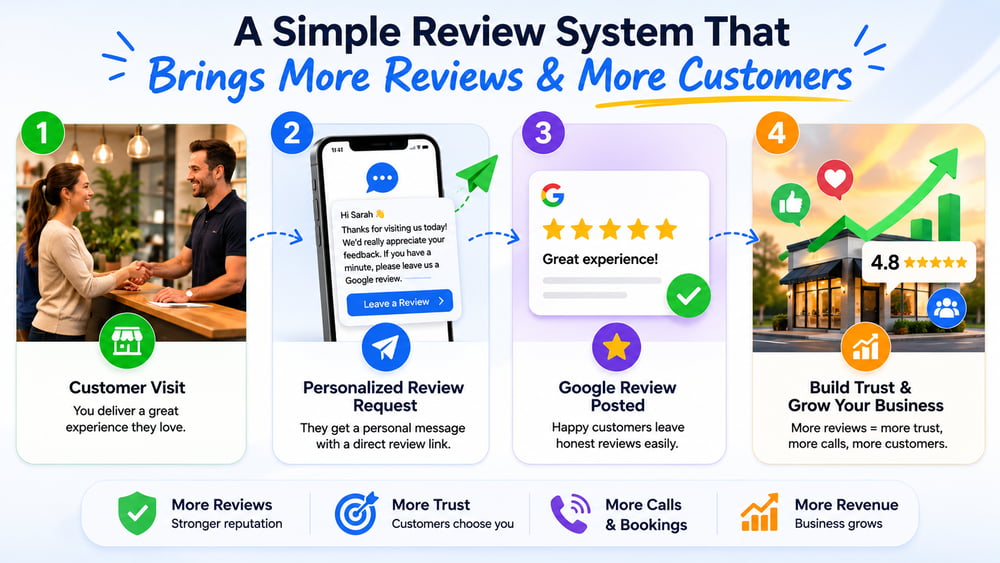
Review Buddy helps local businesses collect more Google reviews without discounts, rewards, or awkward manual asking.
The system focuses on the clean approach:
- Ask real customers
- Send the request at the right time
- Make the message personal
- Include a direct review link
- Keep the request respectful
- Build reviews consistently over time
Instead of bribing customers, Review Buddy helps you capture the happy customer moments your business is already creating.
You can see how Review Buddy works here:
You can view results here:
https://reviewbuddy.ca/results/
You can check pricing here:
FAQ
Can I offer a discount for a Google review?
No, not safely. Google says incentivized reviews can include reviews influenced by discounts, payment, free goods or services, or other benefits offered to the reviewer.
Can I give a gift card for a Google review?
Avoid it. A gift card is a benefit, and offering benefits in exchange for reviews can make the review incentivized.
Can I ask customers for Google reviews?
Yes. You can ask real customers for honest reviews after a real experience. The request should not include rewards, pressure, or instructions to leave a specific rating.
Can I ask for a 5-star review?
Do not ask specifically for 5 stars. Ask for honest feedback instead.
Can I run a review contest?
Avoid review contests. If customers receive a chance to win something because they leave a review, that can influence the review.
What is the safest way to get more Google reviews?
The safest way is to ask real customers for honest feedback with a timely, personal message and a direct review link.
Why are incentivized reviews bad?
They can make reviews biased, mislead customers, violate platform policies, and damage trust.
Final Thoughts
Offering discounts for Google reviews is not worth the risk.
It may look like a fast way to grow your review count, but it can create bigger problems: policy violations, fake-looking reviews, customer distrust, and potential restrictions on your Google Business Profile.
The better option is cleaner and stronger.
Ask real customers. Ask at the right time. Make it personal. Send the direct link. Ask for honest feedback. Follow up once. Stay consistent.
That is how local businesses build real reviews without risking their reputation.

Review Buddy helps local businesses improve their online reputation, automate customer follow-ups, and generate more Google reviews with simple, personalized review request systems.